
Wild Game Cooking
Spanish Quail with Paprika and Onions Recipe

As an Amazon Associate I earn from qualifying purchases.

This is a lovely Spanish quail recipe where you stew the quail with onions, then serve them separate from their broth, which you then eat with pasta. It’s a great date night or weekend dish that works with any white meat poultry.
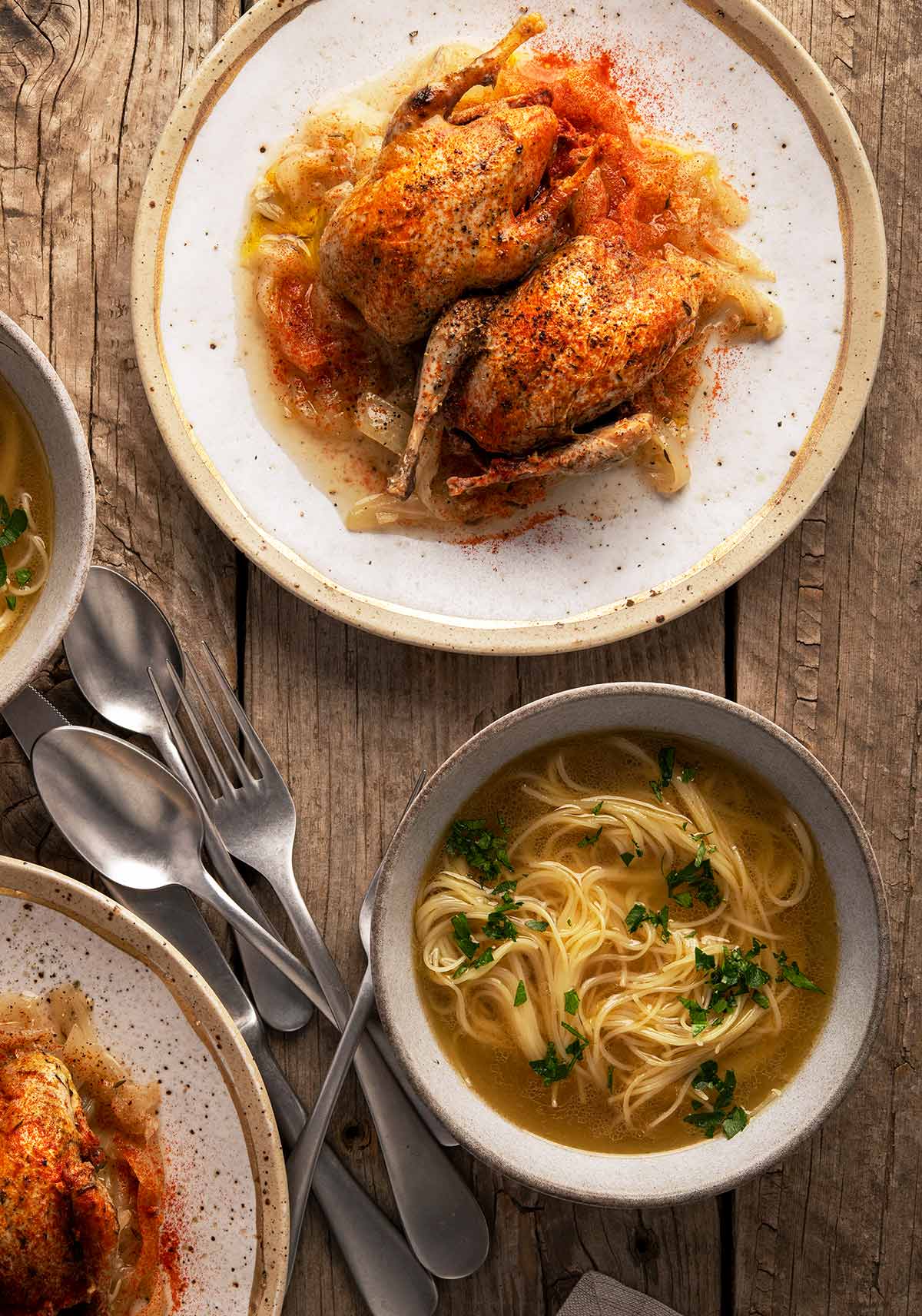
I love this dish because it makes full use of everything you’re cooking, without it being a full-on stew. Europe has a number of dishes like this, where you stew something, then serve the meat and vegetables separate from the broth; French pot au feu springs to mind.
This Spanish quail recipe is similar. It’s called caldereta de cordonices, although it is not very similar to other caldereta recipes I’ve seen. I first read about it in Penelope Casas’ wonderful book The Foods and Wines of Spain.
The original recipe uses Spanish fideo noodles, but I went with Italian angel hair. They are similar, but angel hair is finer and cooks faster, and, since it’s just the pasta and the broth, I find the mouthfeel to be better. The effect is a little like eating Vietnamese pho.
Pasta forms the starchy backbone to this Spanish quail recipe, one you can skip if you feel strongly about it, or are gluten-free. In that case, you could just cook some rice and make it a rice soup. Or skip it altogether.

Quail Alternatives
I am stewing 8 wild quail here, but there is no reason at all you couldn’t sub in other light meats. Some good options include:
- 1 domestic rabbit or 2 cottontail rabbits or 3 squirrels
- 2 Cornish game hens or ruffed grouse
- 1 or 2 chickens, blue grouse or pheasants
- 4 partridges or chukars
In theory, you could use wild turkey thighs, and it would be OK, but they are a little dark. Ditto for darker grouse like prairie chickens, sharp-tailed grouse and ptarmigan.
Cooking Spanish Quail
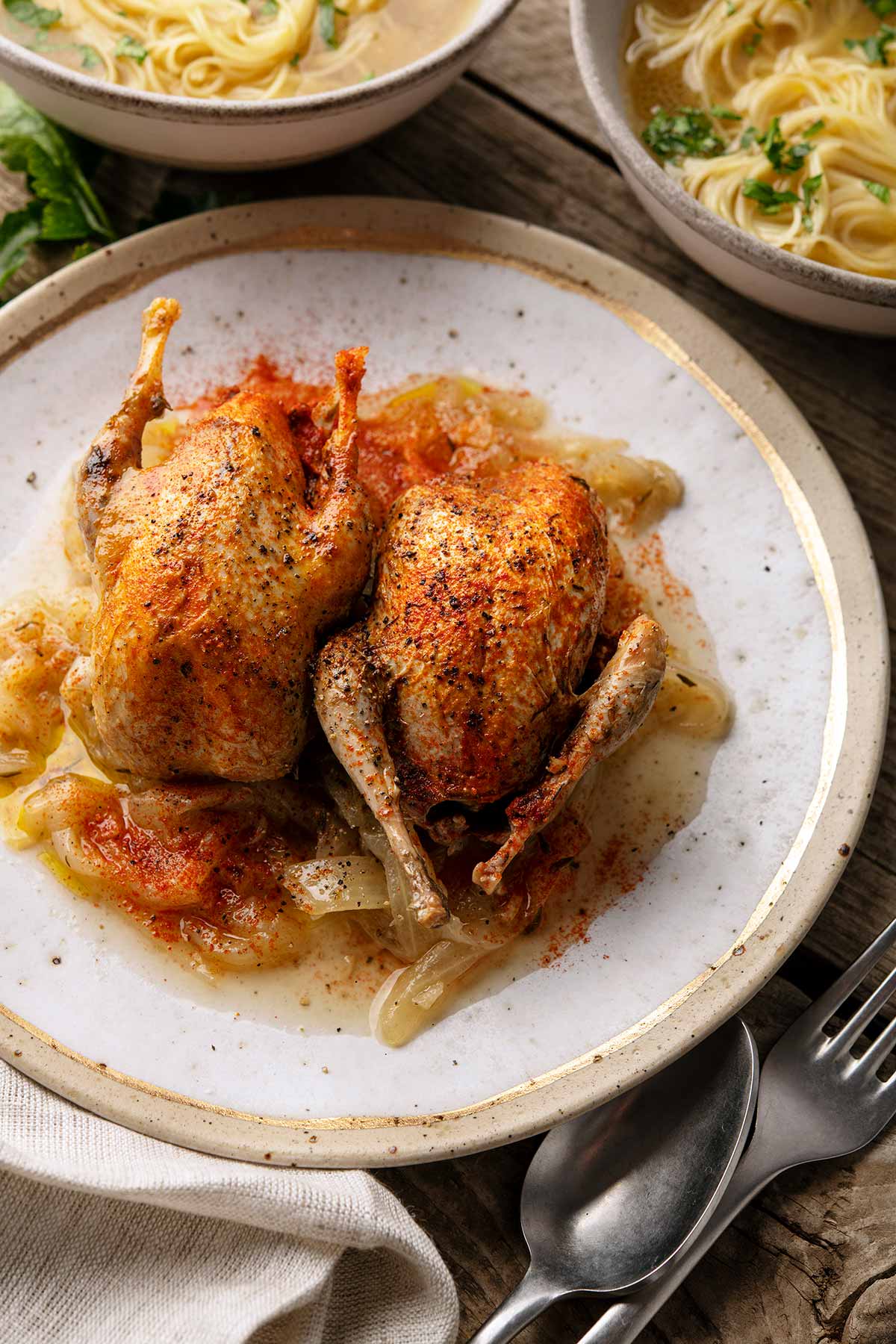
Super easy. Add some olive oil to your soup pot and sauté some onions and garlic. Add the quail, broth, a little vinegar, and some herbs and stew it all until the quail are tender, anywhere from 1 to 2 hours depending on whether you are using farmed quail or wild.
Gently remove the stewed quail, strain the broth, fish out the aromatics, then serve the quail on the onions with some black pepper and paprika.
You cook the pasta quickly — thus the angel hair, which takes only a couple minutes to cook — and put that in bowls with the broth. Doneski.

The broth will keep for a week in the fridge, as will the quails. But the quail are really at their best when they’re ready. That said, if you want to preserve them a while, do this:
- Use just enough of the broth to submerge the birds. Add 3/4 cup of vinegar to that broth and bring it to a boil.
- Put the leftover quail in there, or all of them if you want, and souse them in that acidic broth in the fridge for up to 10 days. They’re great served as a cold lunch.
This is very similar to my recipe for Spanish partridges escabeche.
Other Spanish Recipes
Some other Spanish recipes you might like would be Spanish mushroom rice, merluza en salsa verde, which is a fantastic recipe for fish in an herby green sauce, and the king of all stews, chilindron.
If you liked this recipe, please leave a ⭐️⭐️⭐️⭐️⭐️ rating and a comment below; I’d love to hear how everything went. If you’re on Instagram, share a picture and tag me at huntgathercook.
-
Heat the olive oil in a large, lidded pot like a Dutch oven over medium-high heat. When it’s hot, sauté the onions until they just start to brown a little. Stir in the garlic and cook another minute.
-
Add the quail, stock, vinegar, parsley stems, celery stalk, and thyme and bring to a simmer. Add salt to taste. Cover the pot and simmer very gently until the quail are tender, about 1 to 2 hours depending on whether the quail are farmed or wild.
-
While that’s happening, bring a large pot of water to a boil and add salt. This is your pasta water, and you want this ready when the quail are.
-
When the quail are tender, gently move them from the pot to a plate to rest. Strain the broth into another pot, or a bowl (then wipe out the original pot), and fish out the thyme, celery and parsley stems.
-
Cook the angel hair pasta in the salted water for a minute or three, then move some to each person’s bowl. Pour the broth over, and, if you want, chop the leaves from the parsley as a garnish.
-
Serve the quails on the onions, topped with paprika and black pepper. If they’ve cooled too much, pour just a little of the hot broth over them before adding the pepper and paprika.
Calories: 1028kcal | Carbohydrates: 98g | Protein: 66g | Fat: 41g | Saturated Fat: 10g | Polyunsaturated Fat: 9g | Monounsaturated Fat: 18g | Cholesterol: 166mg | Sodium: 241mg | Potassium: 1188mg | Fiber: 5g | Sugar: 7g | Vitamin A: 588IU | Vitamin C: 21mg | Calcium: 95mg | Iron: 11mg
Nutrition information is automatically calculated, so should only be used as an approximation.
Source link: https://honest-food.net/spanish-quail-recipe/ by Hank Shaw at honest-food.net
Wild Game Cooking
Fish Wings Recipe – How to Cook Walleye Wings

As an Amazon Associate I earn from qualifying purchases.
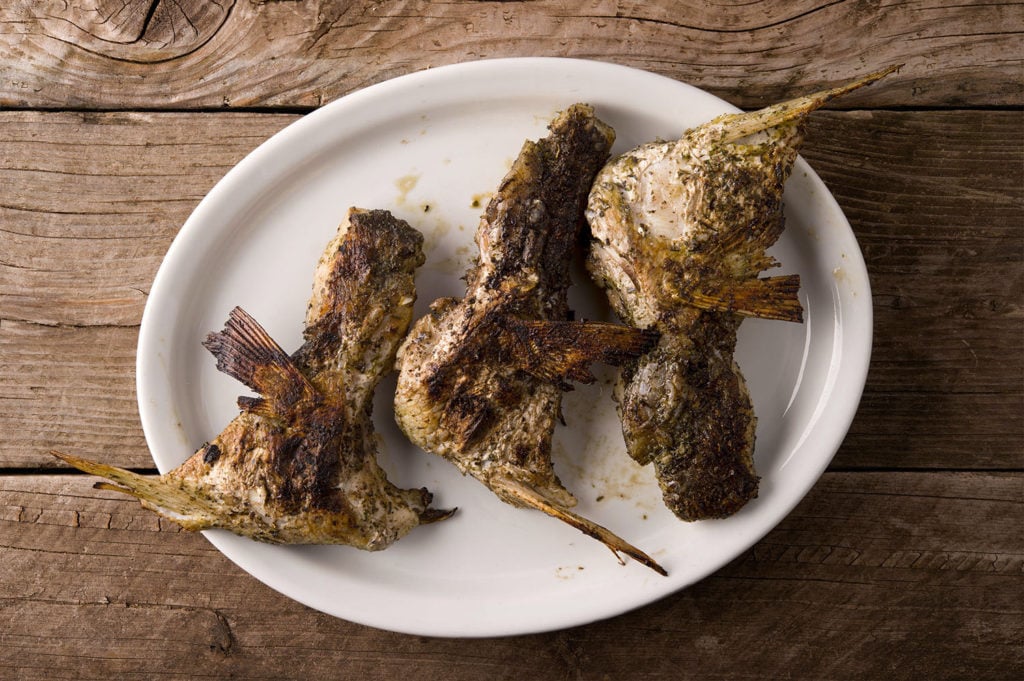
Here’s how to cut and cook fish wings, the collar and belly parts of fish like walleye, snapper and rockfish. Walleye wings are especially popular.
Using fish wings is a great way to get more out of the fish you bring home. They are fun to eat — it’s finger food, like chicken wings — the meat is texturally different from the rest of the fish, and it’s often fattier and richer. Wings, collars and throats are often the best part of a fish.
Depending on the fish and the region you live in, these can be called collars or throats, as in salmon or yellowtail collars, or snapper throats. Cod throats are a thing in New England. Walleye wings are the fish wings of choice in the Midwest.
The cuts are slightly different, but they are all from right behind the head of a fish, and usually include at least the pectoral or pelvic fins, and always the very front of the belly of the fish.
Generally speaking, collars include the arc of meat behind the gill plate and behind the fish’s head. Wings are below that, and include one or two sets of fins, while throats are only the bottom of the belly and may or may not include pelvic fins.
I use heavy-duty kitchen shears to remove them all. Many in the Upper Midwest simply remove walleye wings with the same electric knife they used to remove the fillets. Not being a fan of electric knives, I find the combination of a regular fillet knife plus shears works fine.
Most people cook fish wings either on the grill or they fry them. Both methods are great. I find that if you fry the wings, a very light coating of flour helps get things extra crispy because that flour will absorb any excess moisture; corn or potato starch is an excellent, gluten-free option.
Why leave the fins on? Well, they’re cool-looking, for starters. Second, once fried crispy, you eat the ends of the fins. Yes, you read that right. The ends of the fins get soft enough to eat, are ultra crunchy and not at all fishy in a bad way. You’ll thank me later.
Sauces for Fish Wings
Basically anything goes. I’ve seen anything from Lawry’s lemon pepper and butter to teriyaki sauce, to old-school Buffalo wing sauce to barbecue sauce. Here are some good ones for fish wings:
- I love tossing the cooked wings or collars with a honey mustard sauce, which is great on chicken wings, too.
- A Japanese ponzu sauce works fantastically, especially with salmon or trout collars.
- I marinate collars and fish wings sometimes in a ponzu-like sauce. I do this especially for hamachi kama, yellowtail collars. Any large collar works.
- A very simple, Mediterranean-style olive oil, herb, and lemon marinade is great, too. This is my go-to for all lean fish collars, like from striped bass or big snapper.
- Another good option is a straight-up barbecue sauce. I am fond of this Chinese-style char siu barbecue sauce.
Serving and Storing
Fish wings, collars, etc. don’t keep well. They’re oddly shaped, so while you can freeze them, they tend to break seal in vac bags, and their shapes lend themselves to air pockets however you store them, which leads to freezer burn.
My advice is celebrate your harvest with wings and collars right after fishing. Sure, they’ll keep several days in the fridge, but eat them fresh. You’ll like them better that way.
If you liked this recipe, please leave a ⭐️⭐️⭐️⭐️⭐️ rating and a comment below; I’d love to hear how everything went. If you’re on Instagram, share a picture and tag me at huntgathercook.
-
Optional Step: Mix 1/4 cup salt with 1 quart of water until the salt dissolves. Brine the fish wings or collars in this in the fridge for 4 to 12 hours. I like to do this before I go to bed, then drain off the brine when I wake up.
-
Alternatively, you can just salt the wings well and set aside while you heat about 1 inch of oil in a large pan. You can also use a deep fryer.
-
Lightly flour the fish wings, pressing it in. Set them aside as the oil heats.
-
If you have lots of wings to fry, set up a warming station in a 300°F oven by putting a cookie sheet in that has a cooling rack set above it. As the wings are fried, set them on this rack in the oven. This will keep them light and crispy so they don’t get soggy on paper towels.
-
When the oil hits 350°F, fry the wings, starting with skin side up. The wings will arc upwards. Press them down with your tongs or spatula until they relax and flatten, maybe 20 seconds. Fry until golden brown, about 4 to 8 minutes per side.
-
If you’re using a sauce, toss the wings in the sauce in a large bowl right before you serve them.
Calories: 243kcal | Carbohydrates: 12g | Protein: 42g | Fat: 2g | Saturated Fat: 0.3g | Polyunsaturated Fat: 1g | Monounsaturated Fat: 0.2g | Cholesterol: 98mg | Sodium: 123mg | Potassium: 953mg | Fiber: 0.4g | Sugar: 0.04g | Vitamin A: 91IU | Vitamin C: 2mg | Calcium: 39mg | Iron: 2mg
Nutrition information is automatically calculated, so should only be used as an approximation.
Source link: https://honest-food.net/fish-wings-recipe/ by Hank Shaw at honest-food.net
Wild Game Cooking
Dan Dan Noodles Recipe – How to Make Dan Dan Noodles

As an Amazon Associate I earn from qualifying purchases.
Dan Dan noodles are likely one of the few Sichuan dishes many Americans know about. Wheat noodles, tossed with sesame paste, soy and chile oil, topped with ground pork or some other meat. But this dan dan noodles recipe is a little different.
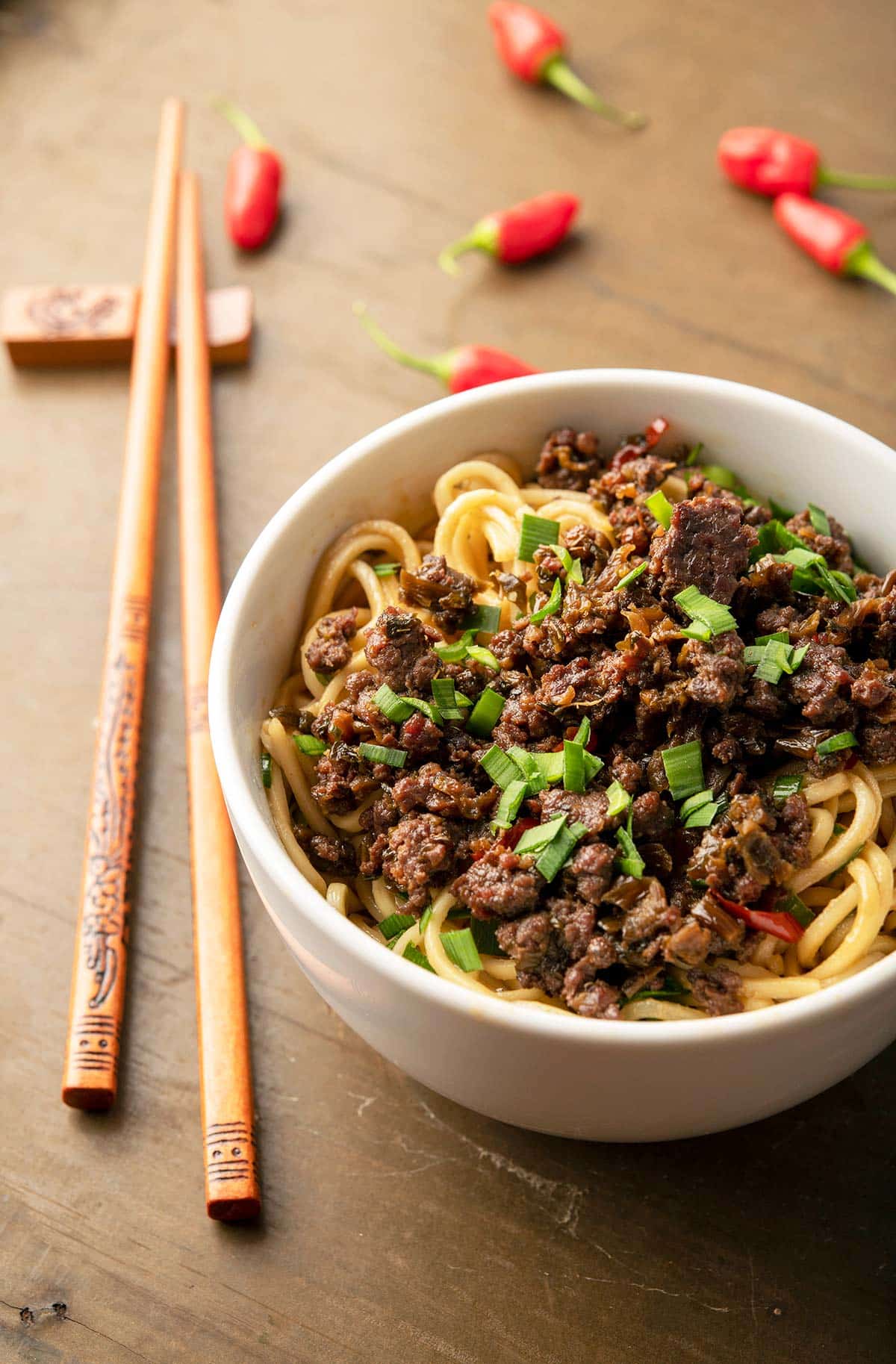
No matter which of the many variations you find, they are all street food, named for a shoulder pole used to carry the pots and ingredients for the noodles, and while its origins are in Sichuan, there are versions of it all over China, as well as here in the U.S.
So, I have to tell you that the first time I ate dan dan noodles, they were gross. It was like eating sweet peanut butter noodles. I swore off them as some nasty side note of Chinese cuisine, until I bought Fuchsia Dunlop’s book The Food of Sichuan. Dunlop, an Englishwoman, graduated from culinary school in Sichuan and is generally considered the authority on that province’s food in the English language. The book is amazing.
And in it are two dan dan noodles recipes, neither of which were sweet or peanut buttery. I later learned that what I disliked about what I’d eaten here was something Chinese chefs did to the dish to make it appeal to American palates. Go figure. Guess I don’t have a typical American palate.
I was especially struck by Mr. Xie’s dan dan noodles, which in Dunlop’s book use ground beef and not pork. The thought struck me immediately. Hey, I happen to have a lot of ground venison and duck in the freezer, and this would be awesome! For those of you squinching your noses, know that once you grind meat, it pretty much tastes like any other red meat.
Neither of the versions Dunlop includes in her book are soupy, which I like. American Chinese versions are often soupy, and it’s not my favorite with this flavor combination.
What are those flavors? Meaty, spicy but not overly so, rich from the sesame paste, a bit salty from both the soy, and the preserved mustard stems that are part of the traditional minced pork topping.

If you want to make this dan dan noodles recipe the way Dunlop does, you will need to get yourself to an Asian market. There are several unusual ingredients in it that are all vital to the flavor. That said, I will give you rough alternatives that are easier to find. It’ll taste different, but will be more accessible to most of you reading this. I’ll also link to online sources of these ingredients if you want to go that route.
- Chief among the special ingredients is Chinese preserved vegetable. Tianjin preserved vegetable or its cousin, yibin yacai. Both are long fermented mustard stems that, when you take them out of the packed or jar, look, well, not like mustard stems. But they are a great source of salty, savory flavor and are worth trying to get. Here’s where I found Tianjin Preserved Vegetable, and I bought Yibin yacai here. If you want to make real dan dan noodles you need one of these. But if you don’t feel like buying them, minced sauerkraut or kimchi will get you into the same galaxy, although they are not really that similar.
- Sesame paste. I know, you’re immediately thinking about buying tahini. And yes, if you have no Asian markets around, go for it. But the Chinese sesame paste doesn’t taste the same. but Dunlop gives us a recipe for making your own by toasting 2/3 cup of sesame seeds until nicely nutty and tan, then grind them well. Bring 5 tablespoons of neutral oil to 355°F and pour that over the ground, toasted seeds. You’ll be good to go.
- Chile oil. You can buy this in most supermarkets, or make it by pouring hot oil over ground hot peppers, with a spoonful of toasted sesame seeds. The general ratio is 4:1 oil to ground chiles, plus a small amount of toasted sesame.
- Sichuan peppercorn. No substitute. You need this. Asian markets all have it, and I buy my Sichuan peppercorns from Penzey’s. Yes, you can skip it, but there is no real alternative ingredient.
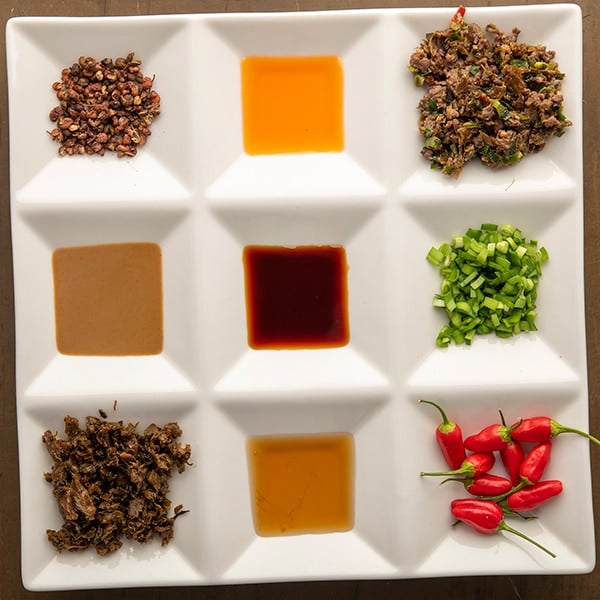
Everything else is easily obtainable from a supermarket. As for the noodles, you want Chinese wheat noodles, but Italian vermicelli is a decent substitute. Definitely check your supermarket’s Asian aisle, though, as they often have the Chinese noodles there.
Putting together an authentic dan dan noodles recipe requires a bit of forethought, but the cool thing is that once you have the ingredients and have made the topping, you are ready to make the noodles whenever you want for about a week, which is how long the topping will keep in the fridge.
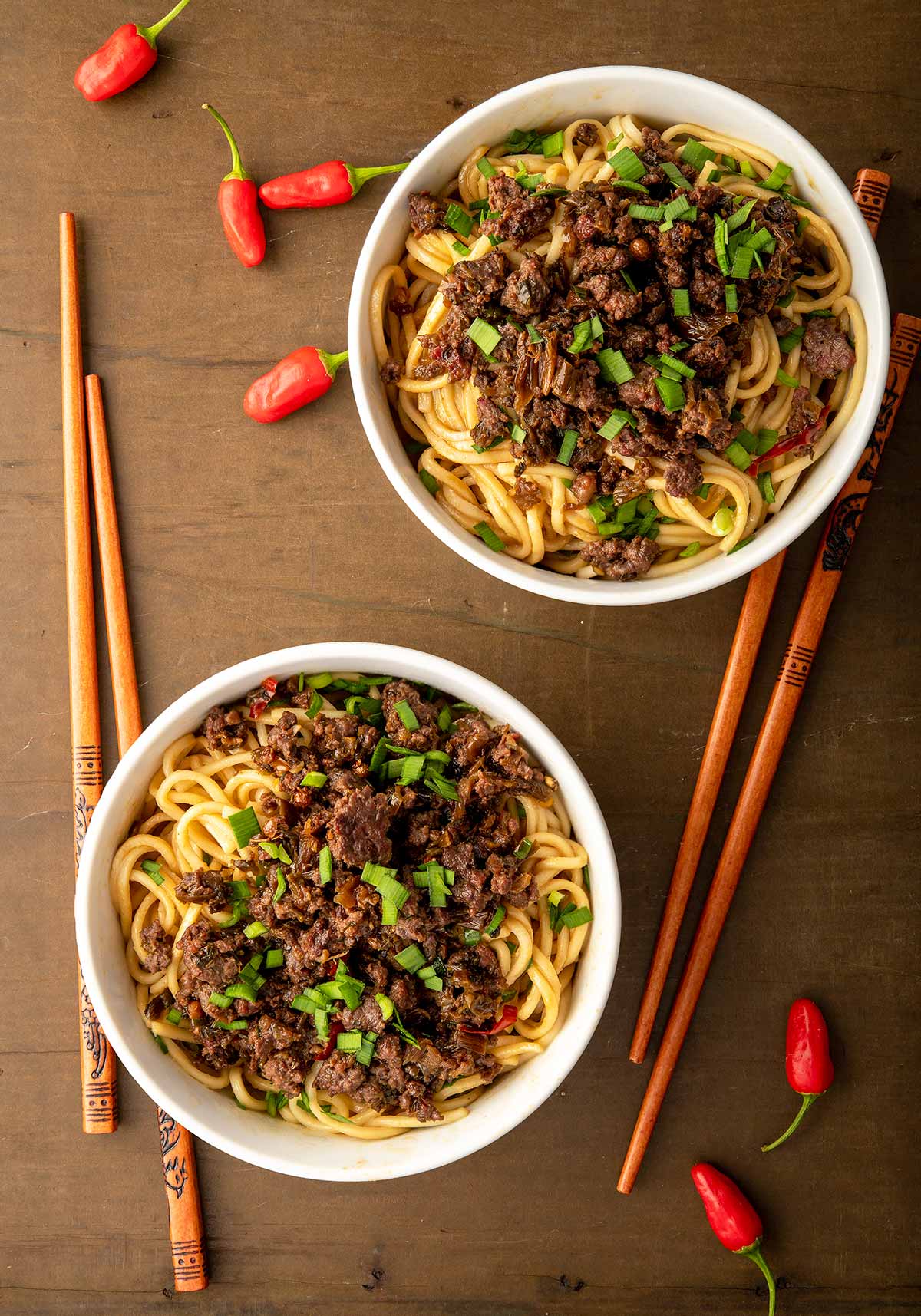
When it comes time to serve, the idea is to boil your noodles, make the topping while the water is heating, put a little of the sauce ingredients in each bowl, top with the meat, then let everyone mix and eat as they want.
If all this sounds like a long walk for a cup of coffee, keep in mind that I was skeptical, too. But once I made real deal dan dan noodles recipe, I was convinced. I think you will be, too.
Incidentally, I cook a lot of Sichuan food. You might want to try my recipes for fish fragrant chicken (or pheasant, or whatever), Sichuan rabbit with peanuts, or twice cooked pork.
If you liked this recipe, please leave a ⭐️⭐️⭐️⭐️⭐️ rating and a comment below; I’d love to hear how everything went. If you’re on Instagram, share a picture and tag me at huntgathercook.

TOPPING
-
Heat the peanut oil in a wok or heavy frying pan over high heat. When it’s hot, add the chiles and stir fry about 30 seconds, until you can smell them. Add the ground meat and stir to combine. Stir fry over very high heat until the meat has browned, then add the remaining topping ingredients, toss to combine and cook for another minute or so. Turn off the heat.
NOODLES
-
Before you even start the topping, get a large pot of water over a burner set over high heat. You want it to be boiling when you are done with the topping, although it’s not critical that both are done at the same time.
-
After the topping is ready and the water boiling, add the noodles and gently stir them so they don’t stick to each other. These typically only need maybe 3 minutes or so to be ready, but follow the directions on the package.
-
While the noodles are boiling, divide all the other noodle ingredients – except for the minced chives – among four deep bowls. To serve, give everyone some noodles over the sauce ingredients, add some topping and some chives, and let everyone stir and mix and eat!
The optional ingredients really make this dish, but if this is your first time, skip them because chances are you’ll need a special trip to buy them, or go via Amazon. That said, if you already like eating Dan Dan Noodles in restaurants, order the special ingredients.
Calories: 598kcal | Carbohydrates: 39g | Protein: 20g | Fat: 40g | Saturated Fat: 8g | Cholesterol: 37mg | Sodium: 1489mg | Potassium: 253mg | Fiber: 3g | Sugar: 2g | Vitamin A: 135IU | Vitamin C: 7mg | Calcium: 17mg | Iron: 4mg
Nutrition information is automatically calculated, so should only be used as an approximation.
Source link: https://honest-food.net/dan-dan-noodles-recipe/ by Hank Shaw at honest-food.net
Wild Game Cooking
Whitefish Salad Recipe – How to Make Whitefish Salad

As an Amazon Associate I earn from qualifying purchases.
A classic recipe for whitefish salad with sour cream, capers, celery and sweet onions. Smoked whitefish is the traditional fish to use, but most fish works. My secret? Mix both smoked and cooked, flaked fish in your salad.
I have a long history with whitefish salad. I grew up in New Jersey, and smoked whitefish and chubs were and are a staple at most Jewish delis. As a kid, I loved buying a chub and some good mustard and saltines and chowing down on that for lunch.
Whitefish salad was for sandwiches. It’s basically a tuna salad, which is why this recipe works even if you don’t have smoked whitefish. Many traditional versions are heavy on the mayo and kinda “wet,” which I don’t love.
This recipe is chunkier, and crunchier, and I split the mayo with sour cream. For the pictures, I used a combination of poached, flaked lake trout and smoked whitefish. A few tips to make your salad shine:
- Use a combination of smoked fish and either leftover fish, or, poach some fish, flake it out, and add to the bowl.
- For a serious pro tip, mix smoked fish with flaked crabmeat. It’s mad crazy good.
- Only use sweet onions, like vidalia or maui or walla walla sweets. It’s important. Skip the onion and go with chives or scallions if you can’t get sweet onions.
- If you don’t like capers, skip them. But use only the little ones, or chop the bigger ones.
- If you feel like it, add a tablespoon of mustard to the mix. It is a nice touch. If you do this, skip the horseradish.
- If you have an undying hatred of celery, or just want to mix it up, use a few tablespoons of pickle relish, or mince some pickles for that tang and crunch.

Serving and Storing Whitefish Salad
Whitefish salad is best eaten right after it’s made, but you can store it in a closed container in the fridge for a few days. It does not freeze well — although both smoked fish and cooked, flaked fish do freeze nicely.
I prefer serving whitefish salad as an open-faced sandwich on rye bread with something like thinly sliced radishes on top, as you see in the picture. It’s also amazing on a toasted bagel; “everything” bagel, for me.
A regular “tunafish sandwich” style sandwich works great, too, as does a “tuna melt” with cheese, if that’s your thing (it’s not mine). It’s also good just spread on Saltines or other crackers — Swedish crispbreads, like those made by Wasa, are an excellent option. I suppose you could make a whitefish salad wrap, too.
If you liked this recipe, please leave a ⭐️⭐️⭐️⭐️⭐️ rating and a comment below; I’d love to hear how everything went. If you’re on Instagram, share a picture and tag me at huntgathercook.
-
Put the fish in a bowl and check for tiny bones. Add the remaining ingredients and mix well. Tinker with the lemon juice, horseradish and, if you want it “wetter,” add more sour cream and/or mayo, 1 tablespoon at a time. Served chilled.
Once made, whitefish salad will keep up to 5 days in the fridge.
Calories: 250kcal | Carbohydrates: 4g | Protein: 21g | Fat: 16g | Saturated Fat: 4g | Polyunsaturated Fat: 7g | Monounsaturated Fat: 4g | Trans Fat: 0.03g | Cholesterol: 93mg | Sodium: 266mg | Potassium: 608mg | Fiber: 1g | Sugar: 3g | Vitamin A: 416IU | Vitamin C: 5mg | Calcium: 61mg | Iron: 1mg
Nutrition information is automatically calculated, so should only be used as an approximation.
Source link: https://honest-food.net/whitefish-salad-recipe/ by Hank Shaw at honest-food.net